
Spiritual life
Prayer, formation of conscience and faithfulness to a demanding rule of life, adapted to each member’s family and civic duties.
A Catholic confraternity inspired by chivalry, heir to an Apostolic Blessing received in 599 and dedicated to spiritual life, charity and the sacred guardianship of holy relics.
Apostolic Blessing · 599The Order received its Apostolic Blessing from Pope Saint Gregory I, O.S.B.—Papa GREGORIUS MAGNUS—in 599. This sacred inheritance strengthens its vocation as guardian of holy relics.
The Order
Strength in service of others; tradition in service of the living.
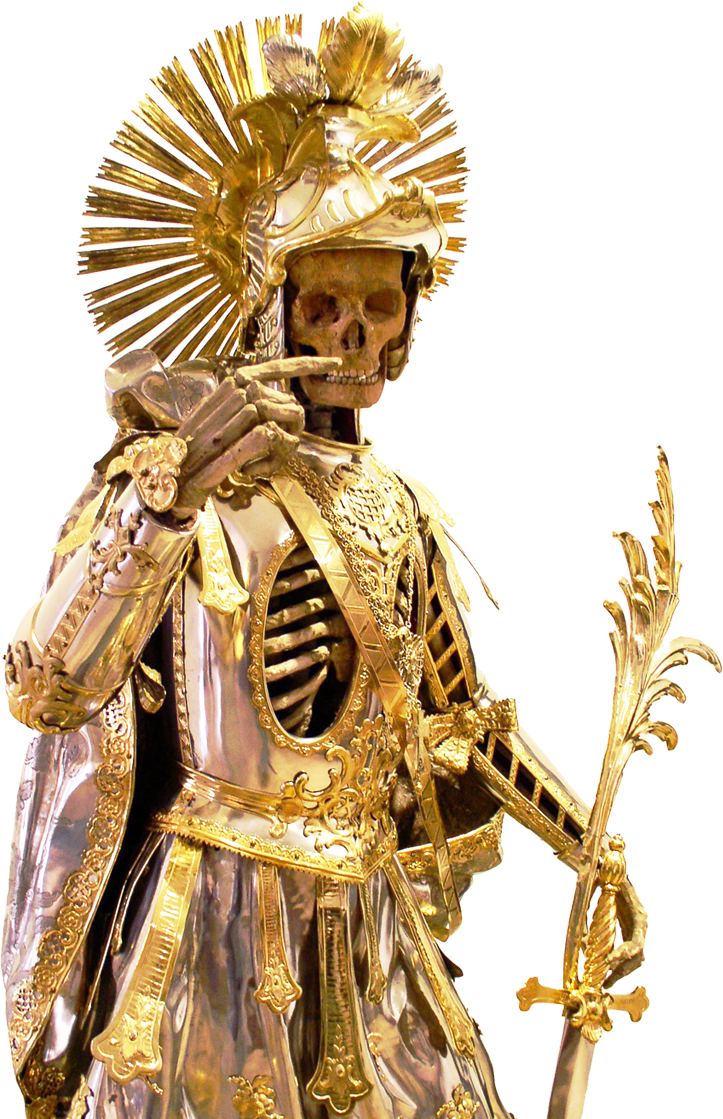
Under the patronage of Saint Sigismund, King of Burgundy and founder of the Abbey of Saint-Maurice in 515, the Order brings together a vocation of prayer, personal discipline, charity and study of Christian heritage. At the heart of this vocation stands the sacred charge to guard holy relics with courage, humility and truth.
Our vocation
Prayer, formation of conscience and faithfulness to a demanding rule of life, adapted to each member’s family and civic duties.
Service to vulnerable people, support for local works and the discreet practice of the works of mercy.
The Order receives as its central charge the protection of holy relics, the documentation of their histories and the preservation of the reliquaries and traditions surrounding them.
The patron saint
Saint Sigismund of Burgundy is not presented as a flawless hero. Christian memory holds together his royal responsibility, grave fault, penance and hope of conversion. That tension is precisely what gives the Order’s patronage its spiritual depth.
Sigismund ruled in the early sixth century, at the meeting point of Roman, Burgundian and Christian worlds.
He founded the Abbey of Saint-Maurice in Valais and fostered the laus perennis, a continuous cycle of liturgical praise.
Tradition remembers a ruler marked by tragic family wrongdoing and by a search for reconciliation with God.
His relics and memory travelled from Saint-Maurice to Alsace, Prague and other centres of devotion across Europe.
Christian courage is not the absence of fault: it is truth, penance and a return to service.
The statutes
The statutes place prayer, charity, personal conduct and accountability at the heart of membership. Authority is understood as a duty of service, never as privilege without responsibility.
Regular prayer, participation in sacramental life, formation of conscience and personal discipline.
Service to the sick, poor or marginalized, support for local works and practical commitment.
Truth, loyalty, justice, worthy conduct and a fair process when the rule is breached.
Cooperation, accountability, respect for family and civic obligations, and priority for the common good.
CommitmentEight obligations summarize this spirit: spirituality, loyalty, honour, charity, courage, fraternity, discipline and service.
The sacred charge
This charge stands at the heart of the Order’s identity. From Saint-Maurice to the present mission, it calls members to protect, conserve, study and carry forward the relics entrusted to Christian memory.
The abbey, its treasury, Alpine pilgrimage and the diffusion of Saint Sigismund’s cult belong to a historical context open to study.
Accounts of custodians, escorts and rescues carry the confraternity’s own memory and give form to its guardian vocation.
Guardianship today means vigilance, provenance, conservation, collaboration with holding institutions and the sharing of knowledge.
Build a rigorous history of each object, its custodians, its journeys and its veneration.
Document and publish with the agreement of responsible churches, museums, communities and owners.
Reject trafficking and sensational exploitation; preserve relics from commercialization.
Use qualified professionals, appropriate materials, and safe conditions for transport, storage and display.
Support the return of objects to their rightful custodians and the repair of contested provenance.
Share records, discoveries and corrections so that the map and archive continue to grow.
Chronicles of the Order
The project’s “Stories” file forms a narrative cycle set amid the confessional conflicts of the seventeenth century. These tales give the guardian vocation an epic shape: disguises, Alpine crossings, hidden reliquaries and fidelity under threat.
Disguised as wool merchants, knights enter an enemy manor and return the lance to Saint-Maurice without choosing open battle.
Brother Lucien follows a refugee priest’s fragmentary account to an abandoned crypt near Lake Constance, where a reliquary is said to have survived the war.
The tradition tells of an armed vigil near Brig, where members protect a monastery and a fragment of cloth attributed to Saint Ursula.
Three companions disguised as herbalists carry a burial-cloth fragment from the Basel region; one draws away the pursuers at the cost of his life.
Knights follow a stolen relic from Sion toward Lausanne and recover it through infiltration rather than display.
Caught in a snowstorm, a small escort holds through the night around a reliquary of Saint Bernard until reinforcements arrive.
Research project
Search 297 records by relic, church or country, then explore places of custody and veneration across the bilingual interactive map.
Milestones
King Sigismund of Burgundy founds the Abbey of Saint-Maurice and establishes the laus perennis, a continuous cycle of liturgical prayer.
After his death, Sigismund is venerated as a martyr. His path — fault, penance and service — becomes an enduring call to conversion.
Remains attributed to Saint Sigismund are transferred to Saint-Maurice, which becomes a major centre of his veneration.
The Order receives its Apostolic Blessing from Pope Saint Gregory I, O.S.B.—Papa GREGORIUS MAGNUS—placing its mission within the continuity of faith and service.
Emperor Charles IV obtains part of the relics for Saint Vitus Cathedral, extending Sigismund’s cult in Central Europe.
After the Napoleonic period, Valais enters the Swiss Confederation as its twentieth canton.
The Abbey of Saint-Maurice celebrates the 1,500th anniversary of its foundation and the continuity of its religious life.
The Order expresses this inspiration through a rule of life, charity, historical study and its sacred charge as guardian of holy relics.
Governance
The statutes organize the Order through spiritual, administrative, charitable and ceremonial offices. Each title names work to be done in service of the common mission.
Current leadership
The current leadership brings together the offices and distinctions entrusted with the Order’s spiritual life, governance and service.
Comte de Valais
Noble Patron and Lord Regent of Saint Sigismund
Grand Prior of Saint Sigismund
Dame of Saint Sigismund (Devotion)
Knight-Banneret of Saint Sigismund
Provides general direction, continuity of mission and promulgation of decisions made under the statutes.
Supports spiritual life, regional chapters and appropriate ecclesial relations.
Oversees protocol, ceremonial order and the logistical coordination of gatherings.
Keeps acts, archives, the seal, registers and official correspondence.
Coordinates care for the sick, visits, relief and health or humanitarian projects.
Organizes works of mercy, collections and transparent follow-through on relief.
Accompanies prayer, formation, moral discernment and relations with ecclesial communities.
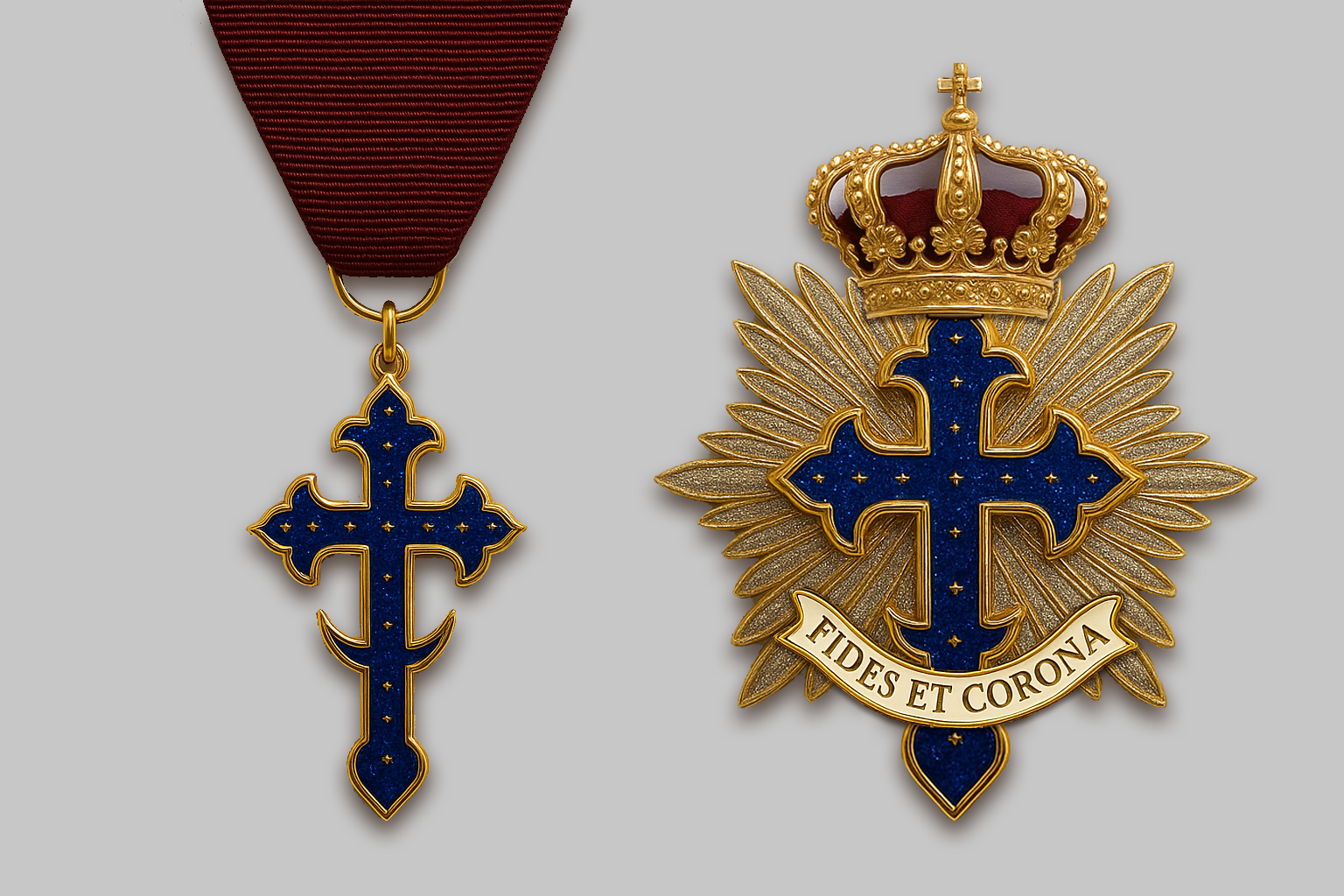
Maintains the armorial register, examines submitted claims and protects accurate use of insignia.


Common life
The Order’s life follows the Christian year and joins feast days to concrete acts of charity, formation and remembrance.
Principal patronal feast, annual chapter, Mass, renewal of commitments and a work of charity.
Meditation on service and, when appropriate, celebration of investitures.
Memory of Agaunum’s spiritual inheritance and prayer for courage in witness.
A work of mercy, prayer for peace and attention to prisoners, displaced people and the vulnerable.
Mass or prayer for deceased knights, dames, benefactors and custodians.
Governance meeting, review of works, formation and a visit to a sacred or heritage place.
Membership
Titles express responsibilities and degrees of commitment. They replace neither virtue, practical work nor the duty of accountability.
“To carry a tradition is not to look backward. It is to accept responsibility for it today.”The spirit of the Order’s rule
Counsel and research
The council brings together complementary forms of expertise to strengthen the Order’s historical, spiritual, heritage and charitable work.
Charters, Alpine institutions, Burgundy, Savoy, Sion and Saint-Maurice.
Reliquaries, metalwork, textiles, inventories, climate, transport and restoration.
Chains of custody, wartime displacement, the art market and repair.
Associational status, ecclesial relations, governance, liability and data protection.
Spirituality, the cult of saints, Christian dialogue and responsible public language.
Source evaluation, palaeography, family records and reconstruction of documentary lineages.